
Enterprise AI without vendor lock-in
Would your AI stack survive a provider change? Practical principles to keep control of your data, Knowledge Graph, and AI applications.
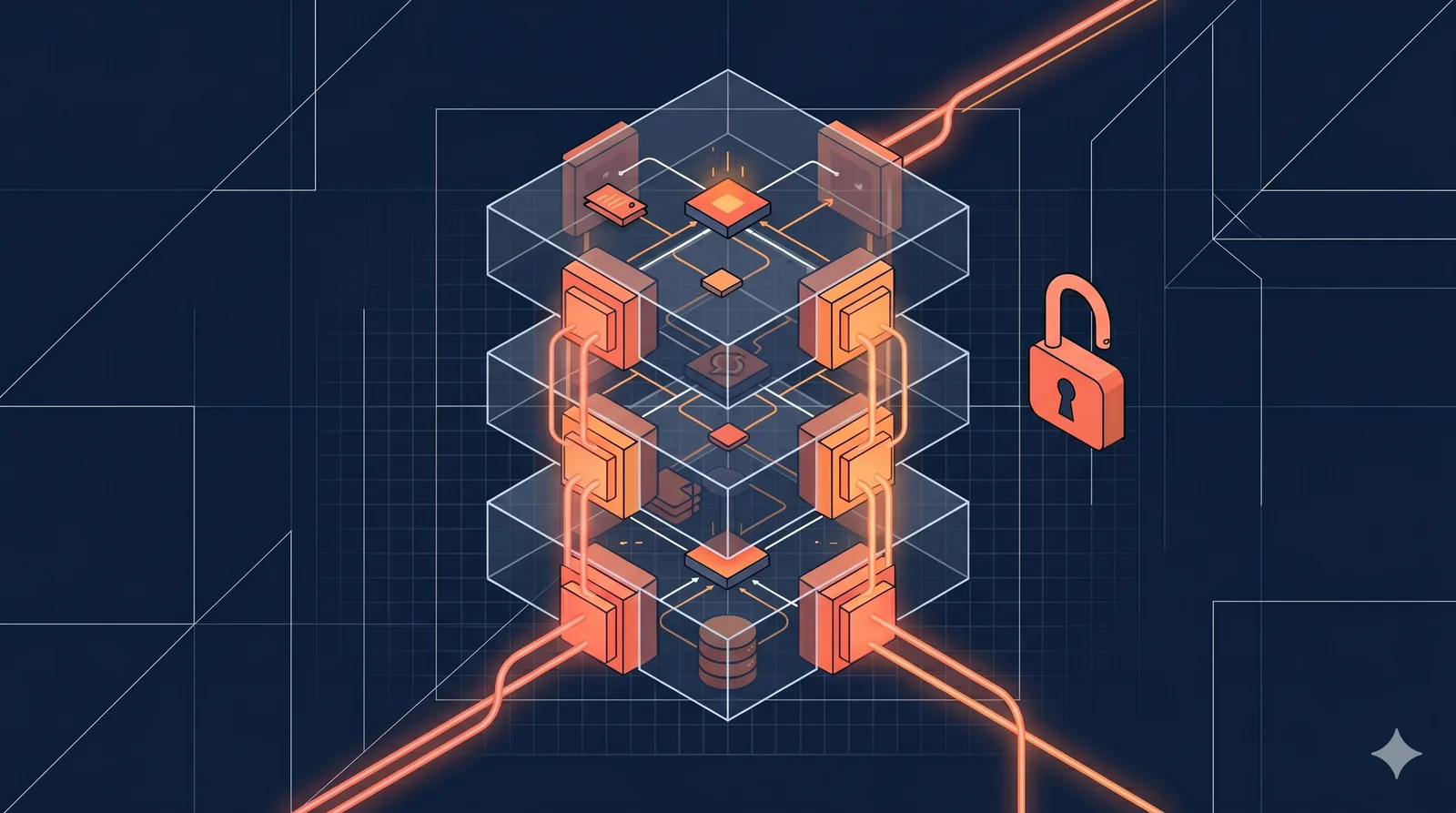
Enterprise AI without vendor lock-in
By separating your data and business knowledge from the technical infrastructure, demanding portability of your Knowledge Graph, and building on a multi-provider architecture. AI lock-in is more dangerous than classic SaaS lock-in: when your AI provider changes the rules, you don't just lose a tool, you lose your team's production capacity.
Why is AI lock-in more dangerous than SaaS lock-in?
Because AI doesn't just store your data, it learns from your processes. The more you use an AI tool, the more it adapts to your context. And the higher the migration cost becomes.
Recent examples: Anthropic changed its billing rules overnight in April 2026, breaking the workflows of hundreds of teams. Heroku closed its free tier. Twitter made its API paid. Google killed entire products. The playbook is always the same: subsidise, capture, monetise.
The difference with AI: when your cloud provider changes prices, you pay more. When your AI provider changes the rules, your agents stop working.
What are the 3 layers to protect?
Layer 1: your data. Your documents, your ERP extractions, your history. It seems obvious, but how many companies know exactly what data flows through their AI tools? Every prompt sent to an LLM is potentially a data leak.
Layer 2: your Knowledge Graph. The relationships between your business concepts, your ontologies, your rules, your patterns. This is the most valuable asset, and the hardest to migrate if it's locked in a proprietary platform. Fewer than 9% of SMEs have a registered intellectual property right. In an AI context, that's a major risk.
Layer 3: your applications. The code, the agents, the workflows. If everything is built on a single provider's API, a pricing change or a change in terms locks you out.
How do you build an AI architecture without lock-in?
Four concrete principles:
Separate knowledge from infrastructure. Your Knowledge Graph must be exportable, portable, and platform-independent. At GenieFactory, the KG is in Neo4j, open standard, exportable to JSON. The client can retrieve it and deploy it elsewhere.
Build multi-provider. Use Claude when it's the best tool, but be able to switch to Mistral, LLaMA, or a local model if prices double or the terms change. This isn't patriotism, it's risk management. GenieFactory uses Claude in production and maintains a local stack with open-source models for critical workloads.
Document automatically. Audit trail, data provenance, decision traceability. If you change provider, all the accumulated knowledge is documented and transferable. This is also a prerequisite for AI Act compliance.
Require contractual reversibility. Reversibility clause, data export, API documentation, transitional maintenance. If your AI provider doesn't offer this, ask yourself why.
AI sovereignty: cloud or on-premise?
Both. This isn't an ideological choice, it's a risk management choice.
Cases that justify local: sensitive data, high volume, critical processes. Cases where cloud remains better: on-demand compute power, frontier models, non-critical cases.
The parallel with multi-cloud is exact: nobody puts everything with a single cloud provider. Why do it with AI?
At GenieFactory, the architecture is hybrid by design. Cloud for frontier models (Claude, GPT). Local stack for critical workloads and sensitive data. The client chooses, and can change their mind.
What is the real cost of lock-in vs the cost of independence?
Lock-in has a hidden cost: the day the provider changes prices (and they will), you have no leverage. Independence has a visible cost: multi-provider architecture is more complex to set up.
But the ratio is clear: the cost of a parallel sovereign stack is a fraction of the cost of total dependency when conditions change. At GenieFactory, the ratio between the platform licence and full internalisation is 1 to 7, the client has the choice, but keeping the platform costs 7× less than rebuilding everything.
Audit the dependency of your AI stack →
Related article: How to achieve AI Act compliance for AI applications?