
Claude vs GPT for enterprise: architecture matters more than the model
Comparison of Claude (Anthropic) and GPT (OpenAI) for B2B use cases: quality, reliability, costs, confidentiality, ecosystem. The right choice depends on your use case, not an editor preference.
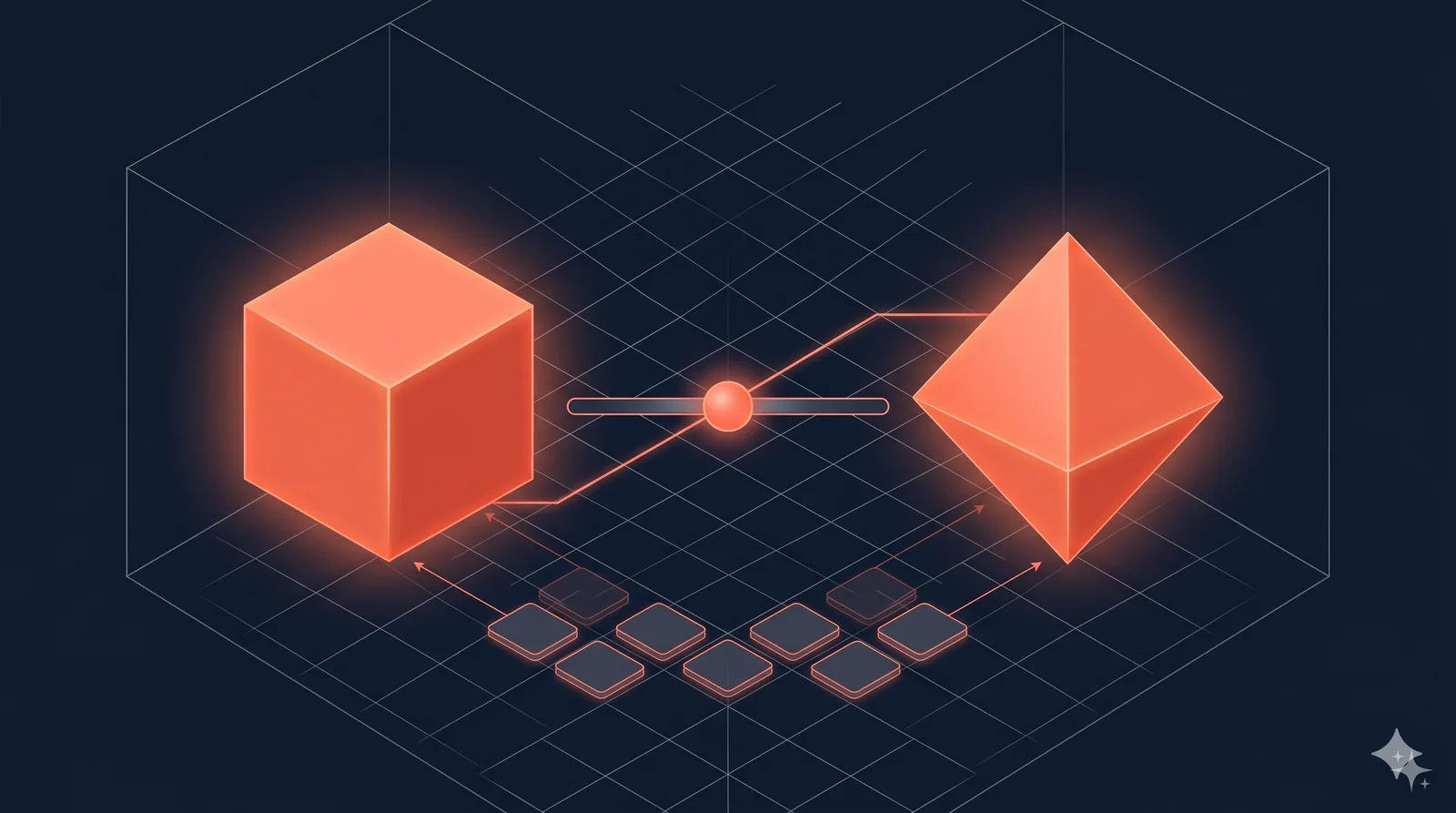
Claude vs GPT for enterprise: how to choose
B2B decision-makers regularly ask the question: Claude or GPT? The short answer: it depends. The useful answer: the right choice is made by evaluating your own use case, not by provider preference. And the architecture that lets you test and switch models matters more than the model itself.
This article is for decision-makers who want to scope a project correctly. It doesn't promise a universal winner, it gives you the criteria to decide in your context.
The two models, briefly
Claude (Anthropic) is recognised for the quality of its structured reasoning, its reliability on complex business tasks, and its native safety guardrails. Available via the Anthropic API, AWS Bedrock, and Google Vertex. Multiple model tiers (lightweight to frontier).
GPT (OpenAI) is the most widely adopted model, with a highly developed tool and integration ecosystem. Available via the OpenAI API and Azure OpenAI. Multiple model tiers as well.
Both evolve regularly, early 2026 versions are not the same as late 2026 versions. What matters for an enterprise decision isn't the benchmark of the month; it's the stable criteria for your use case.
The criteria that really decide
Quality on the specific task. Not "quality in general." A model can excel at extracting structured data and be average at creative generation. The only useful judge is a representative evaluation dataset for your use case. Around a hundred well-chosen examples is enough to discriminate.
Behavioural consistency. In a production setting, what matters as much as the quality peak is variance. A model that is good 95% of the time and catastrophic 5% of the time may be less usable than a model that is "good enough" 99% of the time. Measure the tail of the distribution.
Cost. For a given volume, monthly cost depends on the model tier (lightweight vs. frontier), average prompt size, and strategy (caching, compact prompts, multi-model routing). Both families offer a range from very economical to premium.
Confidentiality and compliance. Both have regional hosting options (Bedrock/Vertex for Claude, Azure OpenAI for GPT). Contracts cover API usage and the non-use of data for training. Point to verify with up-to-date contracts depending on the channel used.
Ecosystem. GPT has the advantage of massive adoption and availability in the Microsoft ecosystem (Azure). Claude has the advantage of seamless integration on AWS and Google Cloud. Depending on which cloud the company already uses, one of the two integrates faster.
Tooling ecosystem. Both expose APIs compatible with agent frameworks (LangChain, Llama Index, Haystack, proprietary solutions). This criterion is no longer differentiating.
Comparison table by use case
| Use case | Key criteria | Natural candidate |
|---|---|---|
| Extracting business data from documents | Reliability, variance, cost | Claude or GPT (evaluate) |
| Contextualised business assistant | Reasoning, answer quality | Claude |
| Generating high-volume first drafts | Versatility, cost | GPT or Claude (evaluate) |
| Reconciliation and control | Reliability, guardrails | Claude |
| Automated classification with high variance | Reliability, cost | Lightweight model (Claude or GPT) |
| Sensitive cases with sovereignty constraint | Europe hosting | Claude (Bedrock/Vertex) or GPT (Azure) |
| Self-hostable scenarios | Maximum sovereignty | Mistral or open-source |
This table is indicative. In practice, one of the two models always wins on the specific case once the evaluation is done.
The trap of the "religious choice"
The worst way to choose is by provider preference. "We're a GPT company" or "we like Claude", these are not criteria. They are biases.
The right process is empirical:
- Build a dataset representative of the use case (100 to 300 examples).
- Run both models on the same dataset with the same prompts (or prompts adapted to each model, measured).
- Measure: quality (accuracy rate on business criteria), variance (spread between calls), latency, cost per call.
- Check non-quality constraints: hosting, contracts, regional availability, ecosystem.
- Decide, and document why.
This process takes a few days. It avoids rebuilding a project 6 months later.
Multi-LLM architecture: the real answer
A decision of this nature should not be irreversible. That's why a well-designed agentic architecture treats the LLM as an external dependency:
- an LLM call abstraction that decouples the orchestrator from the provider;
- an evaluation dataset maintained continuously, to redo the comparison at each major version;
- a multi-model router that directs each task type to the most suitable model (e.g., anonymisation on a local model, extraction on Claude, creative generation on GPT);
- cost and quality monitoring per model.
With this architecture, changing model does not rebuild the agent. That is the real portable property: not the code itself, but the portability of the decision.
What about Mistral and open-source?
For some cases, self-hosting is a strong criterion, maximum sovereignty, sector constraints, very high volumes. Mistral (French, with Mistral Large and Mixtral models) and open-source models (Llama, Qwen, others) are relevant options. Infrastructure cost may exceed that of an API, but self-hosting eliminates dependency on an external provider.
The principle remains the same: decide by evaluation on the specific case, not by assertion.
What to take away
Claude and GPT are both excellent models for enterprise use cases. The winner for your project depends on your use case, your constraints, and your cloud, not on a general ranking.
The most important thing: build an architecture that does not lock you in to one model. Today's choice should not be tomorrow's cost.
To go further, see the Claude for enterprise page or the guide to industrialising a Claude agent.
Frequently asked questions
- Claude or GPT: which is better for enterprise?
- Neither in absolute terms. The right choice depends on the use case: required quality on the specific task, cost constraints, confidentiality requirements, regional availability, tool ecosystem. In a well-designed architecture, both can be tested against the same evaluation datasets.
- Is Claude better than GPT at reasoning tasks?
- Claude is often noted for the quality of its structured reasoning and behavioural consistency on complex business tasks. GPT remains highly competitive, particularly on versatility and ecosystem. The gaps depend on the specific case, that's what an evaluation measures.
- Is GPT cheaper than Claude?
- Pricing varies by model version (lightweight or frontier models) and changes regularly. In general, both families offer a range from very economical to premium. Cost depends mainly on call volume and prompt strategy, not on the provider alone.
- Can you use Claude and GPT in the same application?
- Yes, and it's actually a best practice. An LLM router directs each task to the most suitable model: Claude for sensitive extraction, GPT for creative generation, a local model for prior anonymisation. Multi-LLM architecture is an advantage, not a complexity to avoid.
- Where is Claude hosted for Europe?
- Claude is available via the Anthropic API, AWS Bedrock (multiple regions including Europe), and Google Vertex. For processing in Europe with existing cloud contracts, Bedrock and Vertex are practical options. The choice depends on which cloud the company already uses.
- Where is GPT hosted for Europe?
- GPT is available via the OpenAI API and Azure OpenAI (multiple regions including Europe). For processing in Europe with contractual guarantees, Azure OpenAI is often chosen by CIOs already in the Microsoft ecosystem.
- How do you choose between Claude and GPT for a business project?
- By evaluation, not by opinion. Build a representative dataset for the use case, run both models on it, measure quality, latency, cost, and variability. Confirm confidentiality, regional, and contractual constraints. The winning model is often use-case-specific.
- What about Mistral and open-source models?
- Mistral and open-source models (Llama, Qwen, others) are relevant when self-hosting or data sovereignty are strong criteria. They can be more expensive in infrastructure but eliminate dependency on an API provider. As with Claude vs GPT, it's a use-case decision, not a religious war.