
Industrialising a Claude agent in enterprise: method, guardrails, governance
Moving from a Claude chatbot to an industrialised Claude agent in production: architecture, Knowledge Graph, guardrails, human supervision, AI Act compliance. The GenieFactory method.
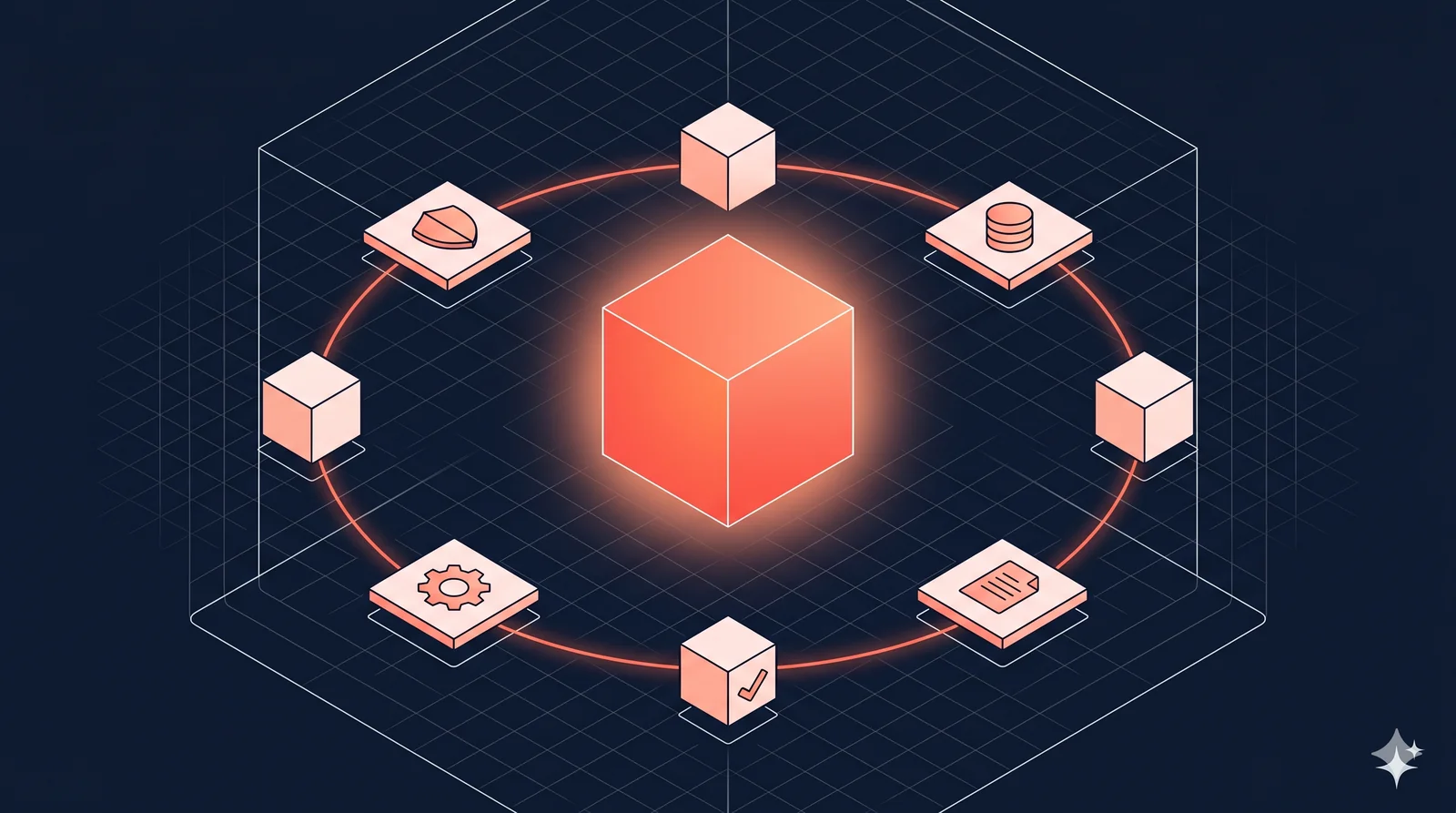
Industrialising a Claude agent in enterprise
Claude is a powerful language model. A Claude chatbot in a chat interface is useful but limited. An industrialised Claude agent in production is something else: a business system that reads your data, executes actions in your SI, applies your rules, traces its decisions, and goes through human supervision. This article describes how to get from one to the other.
A Claude agent is not a Claude chatbot
The difference comes down to one sentence: Claude is a model, the agent is a system.
A Claude chatbot receives a question, Claude responds. It's a convenient interface, but disconnected from the SI, without automatic application of business rules, without exploitable logs for audit, without case-by-case supervision.
An industrialised Claude agent adds around the model:
- an orchestrator that breaks the task into steps and decides when to call Claude;
- connectors that read and write to your ERP, CRM, or business software;
- a Knowledge Graph that encodes your business rules, codes, customer variants, and edge cases;
- guardrails on the input (what gets sent to the model) and output (what is accepted back);
- audit logs to trace every decision;
- configurable human supervision by case type.
The model remains an external dependency. The agent is everything around it.
Why industrialise rather than deploy a SaaS tool?
A public Claude SaaS tool solves an individual use case. A company needs something different: SI integration, own business rules, confidentiality, audit, supervision, ownership of the configuration. A generic tool doesn't do that.
Industrialising isn't reinventing Claude. It's building the enterprise layer that's missing: the connector to your chart of accounts, the guardrail that refuses to send raw tax data to the model, the Knowledge Graph that contains your customer variants, the log that documents every decision for AI Act control.
The ICPC framework applied to a Claude agent
At GenieFactory, the ICPC method structures the production deployment of a Claude agent.
Identify. Which business process? What value? Why now? The right candidate is a high-volume process with documentable rules and a possible human variant at the output. Bank reconciliation, document extraction, email qualification: all are good entry points. A process without clear rules or without volume is not a good candidate.
Frame. Define the expected autonomy level (validate everything, validate in batches, autonomous on standard cases), necessary guardrails, quality indicators, escalation cases. Also frame the hosting: direct Anthropic API, or via AWS Bedrock/Google Vertex in Europe? Both are possible; the choice depends on data sensitivity.
Produce. Build the orchestrator, connectors, Knowledge Graph, guardrails, and supervision interface. Evaluate quality on a representative dataset. Compare with other models (GPT, Mistral) if relevant. Deploy progressively with systematic human validation on the first cases.
Capitalise. Document the Knowledge Graph for subsequent projects, deliver the AI Act system sheet, train internal teams. The application code, configuration, and data remain with the client.
The guardrails to build
A Claude agent in production is never "direct Claude." There is always a guardrail layer between the company's data and the model, then between the model and the action executed.
Input guardrails. Minimise what gets sent to Claude. Redaction of personal or sensitive information not necessary for the task. Reduced contexts rather than database dumps. Length and format filters.
Output guardrails. Validate the response format (expected schema), check semantic consistency, detect probable hallucinations by cross-referencing with the Knowledge Graph. When confidence is low, escalate to the human.
Rights guardrails. RBAC by user and by file. An agent working on a client file only sees the data for that file. Accesses are traced.
Logging guardrails. Every Claude call is logged: input (anonymised if needed), output, decision taken, any human validation. Logs are exportable for AI Act audit.
Confidentiality and compliance
Prompts and responses pass through the Claude API during processing. Anthropic does not use API client data to train its models by default, a point to validate in contracts depending on the API version used.
For sensitive cases, Claude is available via AWS Bedrock and Google Vertex, which enables processing in the Europe region under the client's existing cloud contracts. This meets the sovereignty requirements common in regulated sectors (healthcare, finance, notarial, public sector).
On the AI Act side, the documentation delivered with an industrialised Claude agent includes: system sheet, input-output-decision register, human supervision policy, security measures, incident management procedure. See the AI Act checklist for enterprises.
Multi-LLM architecture: don't lock in on Claude
A well-designed architecture treats Claude as an external dependency, not the core of the agent. The model is called behind an abstraction that allows testing other models (GPT, Mistral, self-hosted open-source) on the same evaluation datasets.
This doesn't prevent choosing Claude when it's the best candidate. It protects the company against a price change, an API evolution, or a better future option. For the model-by-model comparison, see Claude vs GPT for decision-makers.
Ownership and handover
The agent's application code (orchestrator, connectors, guardrails, interfaces), the configured prompts, the business Knowledge Graph, and the logs belong to the client. Everything is delivered in the client's repository and deployable on their infrastructure.
What remains external is the model consumed via API. But the essential value created, the encoded business rules, the SI integration, the governance, is the property of the client, not the service provider.
How long, how much?
A first Claude agent on a scoped process is industrialised in 6 to 12 weeks, from expressing the need to supervised go-live. Timelines vary with the complexity of SI integrations, the number of business variants, and the supervision level required.
On costs, the Claude API is generally a minority share of the total cost. The bulk is in engineering: framing, Knowledge Graph, connectors, guardrails, monitoring, AI Act documentation, training. GenieFactory prices a Claude agent as a fixed fee per process, not per API call.
Where to start
Identify a high-volume process with documentable rules. Write the ROI in one sentence. List confidentiality constraints that determine the choice between direct Anthropic API and Bedrock/Vertex hosting. Frame a first tight scope, one agent, one process, one deliverable.
The rest is a question of methodical execution, not magic. To go further, see the Claude for enterprise page or contact the team to scope a project.
Frequently asked questions
- What is an industrialised Claude agent?
- It's a business system built around the Claude model: orchestrator, SI connectors, Knowledge Graph, guardrails, audit logs, human supervision. The model is one component among others. The industrialised agent executes business tasks in production, not chat dialogues.
- Why isn't a Claude chat interface enough?
- Because a chat doesn't integrate with the SI, doesn't apply company business rules, doesn't trace its decisions for AI Act auditing, and can't be supervised case by case. An industrialised agent does all of this, it's a different object entirely.
- How do you integrate Claude into the information system?
- Via API (Anthropic, AWS Bedrock, Google Vertex) with an agentic architecture: orchestrator, dedicated business connectors (ERP, CRM, sector software), input and output guardrails, logs. GenieFactory builds and delivers the integration in the client's repository.
- What guardrails are needed for a Claude agent in production?
- Input guardrails (filter data sent to the model), output guardrails (validate the format and content returned), rights guardrails (RBAC by user and by file), logging guardrails (auditable logs), and human supervision (configurable validation). None are optional for a production agent.
- How do you manage confidentiality with Claude?
- By design: minimise data sent, anonymise where possible, host via AWS Bedrock or Google Vertex in the Europe region for sensitive cases, contracts covering API usage, audit logs on the client side. Anthropic does not use API client data to train its models by default.
- How do you document a Claude agent for the AI Act?
- System sheet (purpose, data processed, risk level), input-output-decision journal, human supervision policy, security measures, incident management procedure. GenieFactory delivers this documentation with each deployed agent.
- How long does it take to industrialise a Claude agent?
- A first agent on a scoped process is typically delivered in 6 to 12 weeks, from expressing the need to supervised go-live. Timelines depend on SI integrations, the complexity of business rules, and the level of supervision required.
- Can you migrate from a Claude agent to another LLM?
- Yes, if the architecture was designed as multi-LLM. The model is an external dependency; the agent is composed of portable components. A model change requires re-running quality evaluations, but not rebuilding the orchestrator, connectors, or Knowledge Graph.