
Industrialising AI in enterprise: why 88% of projects never reach production
Between 80 and 95% of AI projects never make it past the PoC stage. Analysis of McKinsey, MIT, BCG, and Gartner data to understand the obstacles and what leaders do differently.
Industrialising AI in enterprise: why 88% of projects never reach production
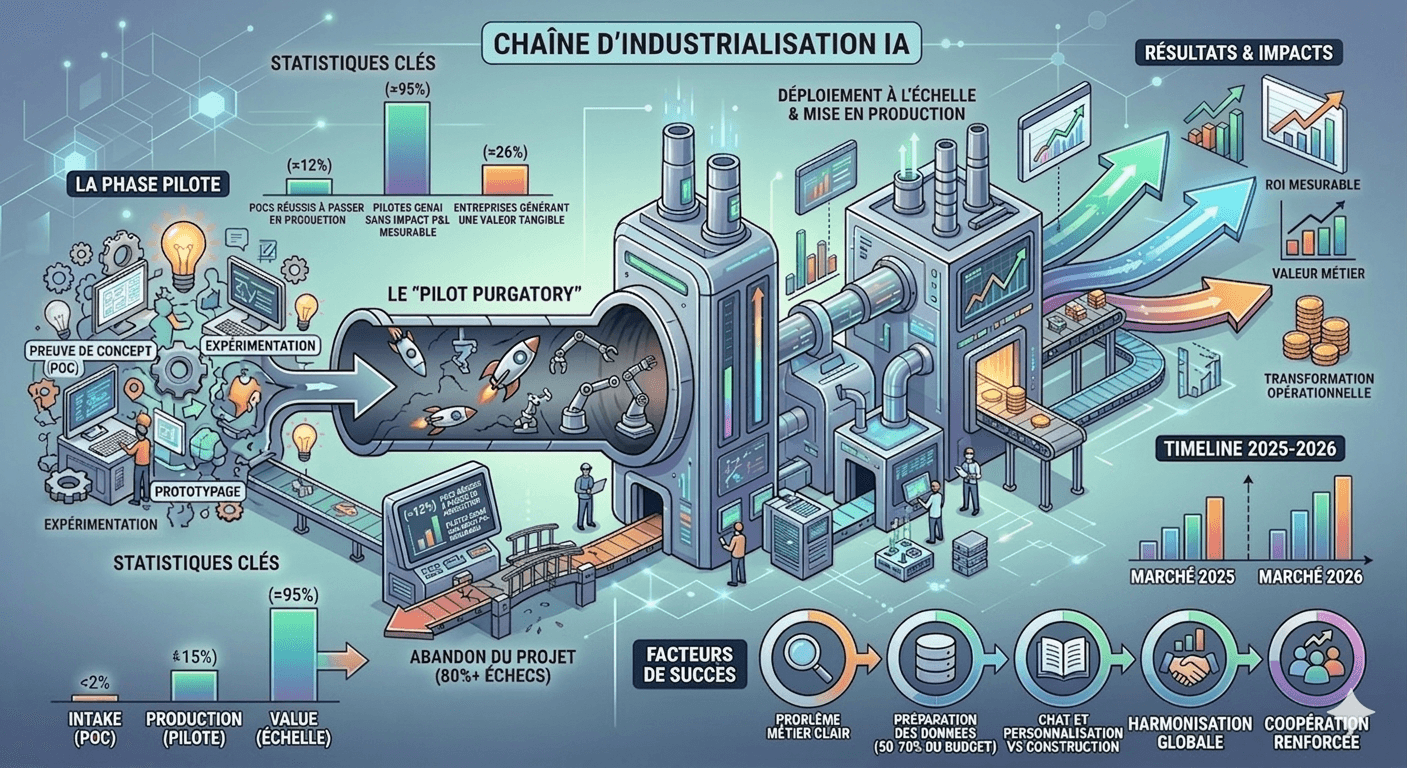
Every company is launching AI PoCs. Very few actually put them into production. This phenomenon, dubbed "pilot purgatory," has become the #1 strategic challenge for executives in 2026. This article analyses data from major consultancies (McKinsey, MIT, BCG, Gartner) to understand the real obstacles to AI industrialisation, and the factors that separate leaders from laggards.
Between 80 and 95% of AI projects never reach large-scale production, that is the central finding from all studies published between 2024 and 2025 by major global consultancies. While 88% of organisations report using AI in at least one function (McKinsey, 2025), only a third have truly begun to industrialise their use cases. In France, where only 10% of companies with more than 10 employees use AI (INSEE, 2024), the gap between ambition and reality is even more pronounced.
This disconnect between PoC buzz and production reality is the structural challenge for executives over the next two years. The phenomenon now has a name in the industry: "pilot purgatory", that grey zone where AI projects stagnate indefinitely between prototype and operational deployment.
How big is the "pilot purgatory" problem really?
The data converges strikingly. According to an IDC/Lenovo study (2025), out of 33 PoCs launched by a company, only 4 reach production, an 88% failure rate. The MIT NANDA report "The GenAI Divide" (August 2025) is even more severe: 95% of generative AI pilots produce no measurable impact on the P&L. Of all GenAI solutions evaluated, 60% are analysed, 20% reach pilot stage, and only 5% go into production.
Other sources offer comparable orders of magnitude. The RAND Corporation (2024) puts the overall AI project failure rate at over 80%, double the failure rate of classical IT projects. S&P Global Market Intelligence (2025) reveals that 42% of companies abandoned the majority of their AI initiatives in 2025, up from 17% a year earlier, a spectacular doubling.
The average time from prototype to production is 8 months according to Gartner (2024), but MIT Sloan observes a significant gap between theory and practice: 18 actual months vs. 6 planned months. The only notable exception: mid-market companies, which reach full deployment in an average of 90 days, nearly three times faster than large enterprises.
Why do so many projects fail?
Cross-analysis of the studies reveals a clear hierarchy of obstacles, dominated by organisational rather than technological factors. BCG summarises this reality with its 10-20-70 rule: AI success rests 10% on algorithms, 20% on data and technology, and 70% on people, processes, and cultural transformation.
Data quality is systematically cited as the first obstacle. Gartner estimates that 85% of AI failures are directly linked to data quality. PoC data, carefully cleaned in a controlled environment, never reflects operational reality, what practitioners call the "clean sandbox fallacy." IBM estimates the cost of poor data quality at 15% of revenue.
The skills shortage hits Europe hard: 70.89% of European companies that considered AI but didn't adopt it cite lack of expertise as the main barrier (Alice Labs/GAIAI, 2026). In France, 166,000 AI-related job postings were published in 2024, a European record.
Next come lack of a business sponsor (73% of failures according to Gartner), integration with legacy systems, and exploding LLM consumption costs that often exceed the projected ROI.
"Shadow AI" constitutes an emerging risk: 75% of employees use non-approved AI tools (vs. 22% in 2023), and company data pasted into GenAI tools increased by 485% between 2023 and 2024.
What do companies that scale do differently?
Documented success cases share common traits and offer instructive benchmarks.
Renault deployed its MP4AI platform across 8 industrial sites with 50 AI controls and announced €270 million in savings in energy and maintenance in one year. Siemens, at its "Digital Lighthouse" factory in Erlangen, achieved a 69% productivity increase. BMW reduced vehicle defects by 60% through computer vision.
In France, Club Med handles 1 million customer requests via its conversational AI with 40 to 50% automated responses. Sanofi developed GenAIr to automate the drafting of 100–150 page quality reports. Ayvens (Société Générale) is deploying PredictIA in 6 countries to predict automotive resale prices.
The data.gouv.fr barometer, based on an audit of 200 AI deployments in France, documents a median ROI of 159.8% over 12 months, with variations: 165% for SMEs (6.7 months), 155% for mid-market (10 months), and 148% for large enterprises (17 months). Document processing projects (OCR + LLM) show the best results with an ROI of 300–500% in 3 to 6 months.
What is GenAIOps and why is it critical?
The industrialisation of generative AI is giving rise to a new discipline, GenAIOps, which extends traditional MLOps to cover LLM specifics: prompt management, RAG pipelines (Retrieval-Augmented Generation), quality control of non-deterministic outputs, governance of agentic workflows, and token cost management.
RAG has become the default architecture for enterprise knowledge assistants (Forrester, 2025), used in 30 to 60% of use cases. The technical ecosystem has structured itself around mature frameworks: LangGraph for production orchestration, Haystack for regulated sectors, LangChain for rapid prototyping, and LlamaIndex for indexing.
On cost control, emerging best practices include dynamic scaling (30–50% reduction in GPU waste), multi-model endpoints (up to 80% reduction in inference costs), and the use of compact/distilled models offering 80–90% of the accuracy at 25–40% of the cost.
The "build vs. buy" decision has shifted clearly toward buying. MIT NANDA shows that solutions purchased from specialised vendors succeed in 67% of cases, compared to around 33% for internal builds.
Where do France and Europe stand?
Europe faces a paradox. The first global zone to regulate AI with the EU AI Act, it has a structural lag in compute capacity (5% of global capacity) and private investment (12% of global AI funding vs. 74% for the United States).
According to Accenture (2025), 56% of 800 large European companies have not yet scaled a major AI investment. European worker productivity represents only 76% of their American counterpart.
France stands out as the leading European AI hub (5 consecutive years at the top of foreign AI investments in Europe), with over 1,000 AI startups, 16 unicorns, and €1.9 billion raised in 2024. But the 10% adoption rate remains below the European average (13%).
Summary table of key figures
| Indicator | Figure | Source |
|---|---|---|
| Organisations using AI (≥1 function) | 88% | McKinsey, 2025 |
| French companies using AI | 10% | INSEE, 2024 |
| AI PoCs not reaching production | 88% | IDC/Lenovo, 2025 |
| GenAI pilots with no measurable P&L impact | 95% | MIT NANDA, 2025 |
| AI projects failing overall | 80%+ | RAND, 2024 |
| Companies abandoning AI initiatives | 42% (vs. 17% in 2024) | S&P Global, 2025 |
| Average time PoC → production | 8 months | Gartner, 2024 |
| Median ROI in France (200 deployments) | 159.8% | data.gouv.fr, 2024–25 |
| Enterprise GenAI spend (2025) | $37bn | Menlo Ventures |
What do winners do differently?
The five recurring success factors are:
- Start from the business problem, not the technology, 73% of failures are linked to projects chosen for their innovative appeal
- Allocate 50–70% of budget to data preparation, not model development
- Prefer buying and customising, solutions from specialised vendors succeed in 67% of cases vs. 33% for internal builds
- Integrate MLOps/GenAIOps from day one, versioning, automated testing, continuous monitoring
- Invest heavily in change management, 70% of the effort must be directed at people and processes
Accenture adds that "reinvention-ready" companies achieve 2.5× revenue growth and 2.4× higher productivity.
Why is 2026 the year of truth?
AI industrialisation in enterprise is no longer a technology question, the models, platforms, and frameworks are mature. It's a question of organisational maturity: data quality, process redesign, skills, governance, and above all the will to transform rather than simply automate.
For decision-makers, three convictions emerge clearly from the data:
- The gap between leaders and laggards is widening irreversibly, only 5% of companies are truly capturing the value of AI
- Buying and customising is more effective than building, except for highly differentiating use cases
- Real ROI comes not from marginal optimisation but from the complete redesign of value chains
The year 2026 will be the pivotal year, the one where the gap between experimentation and industrialisation becomes the gap between leaders and those left behind.
Want to industrialise your AI applications with a structured approach? Request a demo