
The BMAD method can transform vibe coding into real software engineering
41% of global code is AI-generated, often without architecture or tests. BMAD is the framework that reconciles the power of AI with the rigour of software engineering.
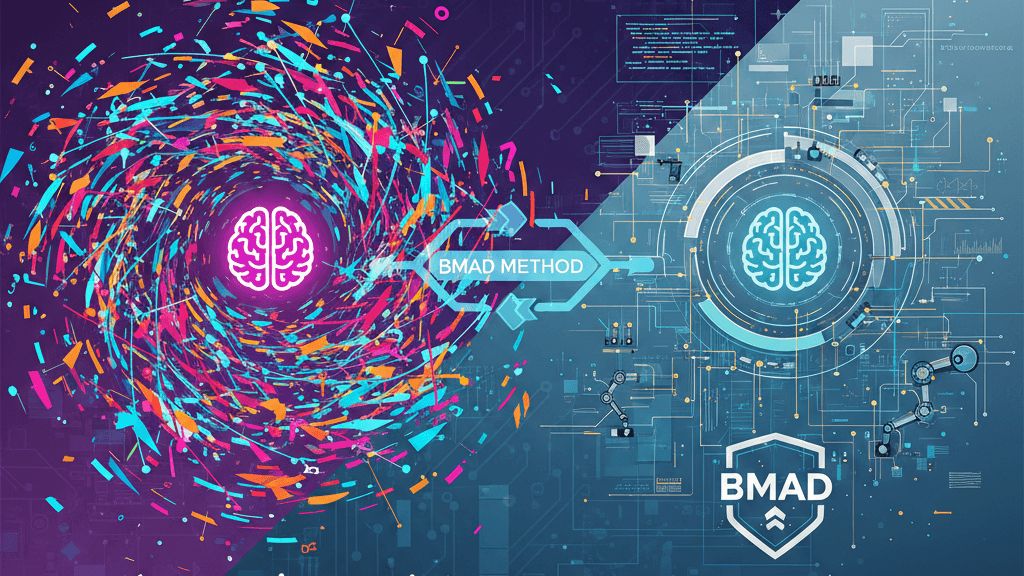
The BMAD method can transform vibe coding into real software engineering
After 20 years of building software products, Mazen Alsarem (Co-Founder & CTO of GenieFactory) analyses why vibe coding is a disaster in the making, and how the BMAD method (Breakthrough Method for Agile AI-Driven Development) brings the rigour of a real engineering team to turn AI into a lasting competitive advantage.
41% of global code is now generated by AI. And the majority of this code is produced without specifications, without architecture, without tests. It's called "vibe coding." It's fast. It's intoxicating. And it's a disaster in the making.
After 20 years of building software products and leading development teams, from the LIRIS/CNRS laboratory to software automation with GenieFactory, I have seen every technology wave promise the same thing: "This time, we won't need rigour." Every time, reality catches up with the enthusiasts. Except that this time, there is a method that reconciles the speed of AI with engineering rigour. It's called BMAD, Breakthrough Method for Agile AI-Driven Development. And it changes the game.
What is vibe coding and why is it a problem?
In February 2025, Andrej Karpathy, co-founder of OpenAI, published a viral post describing his new way of coding: accepting all AI suggestions without reading the code, pasting errors into the chat without comment, letting the project grow beyond his understanding. He called it "vibe coding." The term was voted word of the year 2025 by the Collins English Dictionary.
Today, 92% of American developers use AI tools daily, and 25% of startups in the last Y Combinator batch have codebases that are 95% AI-generated.
The problem? The numbers are damning. A Carnegie Mellon University study of 807 GitHub repositories shows that AI tool adoption increases static analysis warnings by 30% and code complexity by more than 40%. CodeRabbit, after analysing 470 pull requests, reveals that AI co-written code contains 1.7× more major issues and 2.7× more security vulnerabilities than human code. Veracode confirms: 45% of AI code contains security flaws.
The 2022 CISQ report estimates the cost of poor software quality in the United States at $2.41 trillion. And Forrester predicts that 75% of technology decision-makers will face severe technical debt by 2026, directly amplified by unstructured AI development.
The most troubling finding? A controlled METR study of 16 experienced developers shows that those using AI tools were 19% slower, while believing they were 24% faster. The perception gap reaches 39 points. Vibe coding doesn't accelerate development. It creates an illusion of speed that masks a massive accumulation of technical debt.
What do 50 years of software engineering research say?
What these numbers reveal is nothing new to anyone familiar with the fundamentals of software engineering. For half a century, academic and industrial research has demonstrated a simple principle: structure doesn't slow things down, it accelerates durably.
Barry Boehm demonstrated as early as 1981 that the cost of fixing a defect grows exponentially through the development cycle. A bug identified in the design phase costs $80. The same bug found in production? $7,600 according to the Ponemon Institute.
Boehm and Basili established in 2001 that software projects spend 40 to 50% of their effort on avoidable rework, and that 80% of this rework comes from just 20% of defects.
Watts Humphrey's Personal Software Process proves that structured discipline reduces defects spectacularly: teams applying TSP achieve 0.06 defects per thousand lines of code, a hundred times fewer than the industry average. 40% of these teams deliver products with zero defects.
DORA metrics, drawn from the analysis of over 39,000 professionals, demonstrate that the world's best teams don't choose between speed and quality. They excel at both simultaneously, through structured processes.
All these theories converge on a reality that vibe coding ignores: coding is not software development. Software development is a complete engineering discipline with requirements, design, reviews, testing, and maintenance. AI changes the tool. It doesn't change the fundamental laws of software complexity.
How does BMAD structure AI as a real engineering team?
BMAD is an open-source framework (MIT licence) that has accumulated over 33,700 stars on GitHub and federated a growing international community. The founding principle of BMAD is elegant: instead of engaging with AI chaotically, you orchestrate specialised AI agents that reproduce the roles of a professional software team.
Each agent is a versionable Markdown file, a concept called "Agent As Code," inspired by Infrastructure as Code, which revolutionised DevOps.
The BMAD workflow breaks down into four phases:
Phase 1, Analysis: an Analyst agent conducts structured brainstorming (Role Playing, Five Whys, Analogical Thinking) to produce a formalised brainstorming document.
Phase 2, Planning: a Product Manager agent generates a complete PRD with objectives, functional and non-functional requirements, epics, and detailed user stories with acceptance criteria. This is exactly the step that vibe coding eliminates, and that Boehm identifies as the most profitable.
Phase 3, Architecture: an Architect agent designs the technical blueprint (architecture, justified stack, data models, testing strategy, security) with a quality gate at 90% completeness before coding.
Phase 4, Implementation: a Scrum Master breaks the PRD into stories, a Developer agent implements story by story, a QA agent validates each delivery via automatic quality gates.
What distinguishes BMAD from simple "prompt engineering": every artefact produced is versioned, auditable, and persistent. Context loss between sessions disappears. Architectural decisions are documented. Requirements are traceable to the code.
The framework offers three levels of adaptation: Quick Flow for fast fixes (under 5 minutes), the full BMAD method for products and platforms, and an Enterprise mode for projects requiring compliance and scalability.
What is the measurable impact of rigour?
Code reviews, which BMAD integrates via its QA agent, detect 60 to 65% of latent defects according to Capers Jones's data on 12,000 projects. McConnell demonstrated in Code Complete that no single technique exceeds 75% detection: it is the combination of techniques, reviews, testing, static analysis, that maximises quality. BMAD implements this combination by design.
Boehm and Basili established a counter-intuitive but essential fact for every decision-maker: software developed with high reliability costs 53% more to produce, but its total cost of ownership is up to 3× lower than low-quality software. With AI, this investment is further reduced: BMAD automates rigour itself.
The Stripe "Developer Coefficient" study quantifies the stakes: developers spend 42% of their time, 17.3 hours per week, managing technical debt and bad code. The global impact is estimated at $3 trillion in lost productivity.
The Google DORA Report 2025 adds a critical dimension: a 25% increase in unstructured AI usage leads to a 7.2% decrease in delivery stability.
How do you move from vibes to engineering?
Vibe coding is not a developer mistake. It's the natural response to a fascinating technology that isn't yet framed by appropriate processes. Generative AI is the most powerful tool ever placed in the hands of software creators. But a powerful tool without a method doesn't produce value, it produces debt.
BMAD brings the missing piece: a methodological framework that transforms the raw power of AI into reproducible, measurable software engineering. It's not about slowing down innovation, but about giving it solid foundations, exactly as agility structured iterative development without sacrificing velocity.
As an entrepreneur who has built software products in varied contexts, from SEO to PropTech, from strategic intelligence to AI automation with GenieFactory, I am convinced of one thing: organisations that structure their use of generative AI now will gain a decisive advantage over those that continue to "vibe."
The question for every executive is no longer "Should we use AI for development?", it's "With what method?"
BMAD is open source, free, and operational today. The complete documentation is available at docs.bmad-method.org. Vibe coding was a step. AI-augmented software engineering is the destination.
Want to structure your AI development with a proven method? Request a demo