
Stop the PoCs. Move to governed agentic transformation.
80% of AI PoCs never reach production. Here are the 5 main reasons and the method to deploy an AI application that lasts, not a demo that impresses.
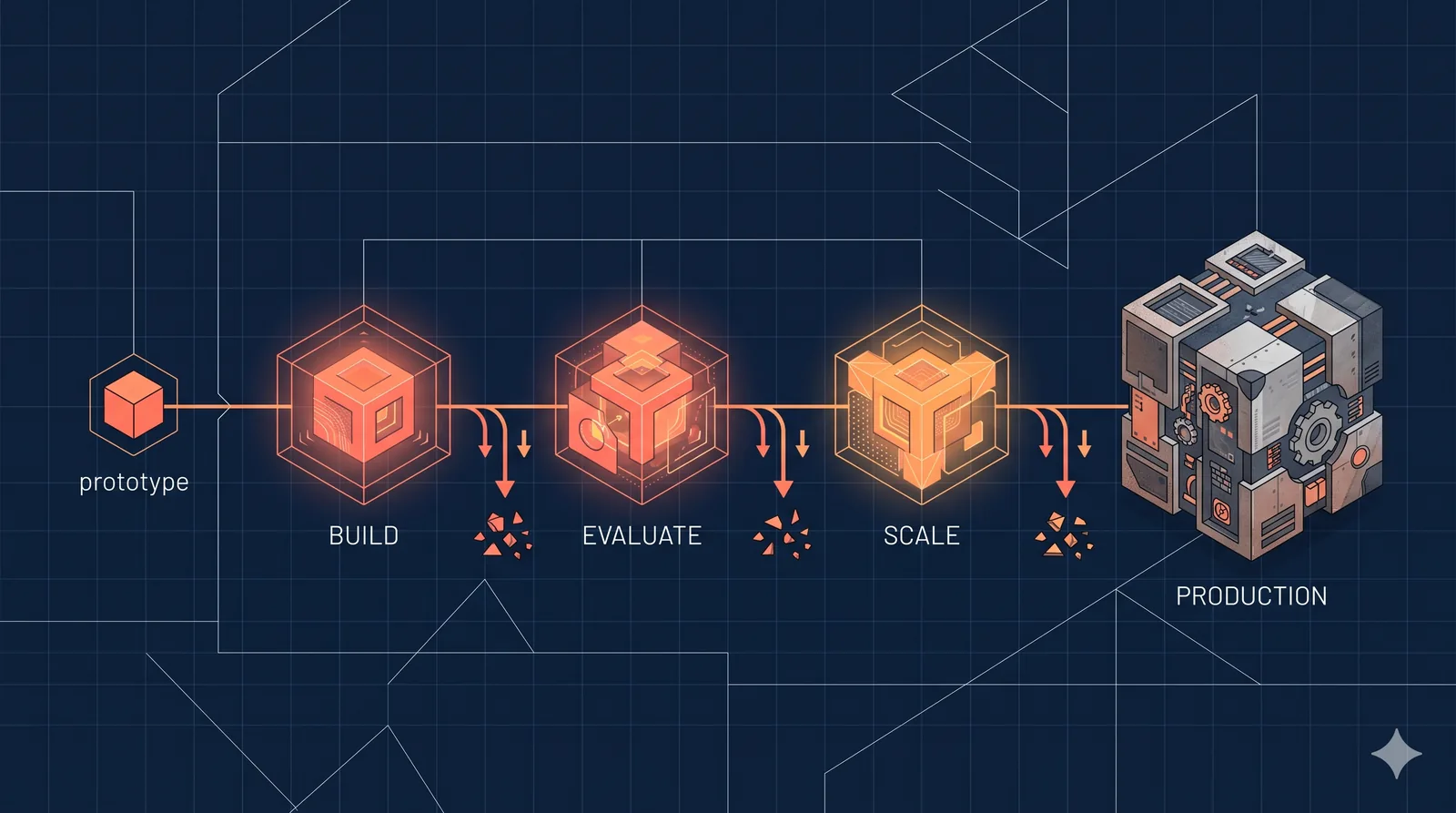
Stop the PoCs. Move to governed agentic transformation.
The question is no longer "how do you make an AI PoC succeed." That's the wrong question. The PoC itself is the problem: designed to impress, not to work, funded from an experimental budget, without capitalisation, without governance. More than 80% of Data and AI projects never reach production, not because the technology is bad, but because the PoC model is structurally incompatible with transformation. Here is why, and how to escape this logic.
Why do most AI PoCs never reach production?
Because they are designed to impress, not to work. More than 80% of Data and AI projects fail. Of the 200 B2B AI projects studied in France, the causes are always the same.
38% fail because of a poor choice of use case. The team tried to automate tasks that required expert judgement. The PoC works on simple cases, but field edge cases kill it.
19% fail through "tool-first thinking." The tool (ChatGPT, Copilot, an app generator) was chosen before the problem was defined. The PoC demonstrates the tool's capability, not business value.
24% fail for lack of an executive sponsor. A middle manager launches the PoC without leadership alignment. Six months later, the budget is cut.
12% fail through lack of change management. The PoC is deployed without explanation, result: 8% adoption.
What is the difference between a PoC and a production project?
A PoC proves that a technology works. A production project proves that a business process is improved. They are not the same thing.
| Classic PoC | Production project | |
|---|---|---|
| Objective | Show that it works | Solve a business problem |
| Data | Clean sample | Real, dirty, incomplete data |
| Users | The project team | Real field users |
| Lifespan | 3 months then forgotten | Continuously in production |
| Validation | Demo to committee | Adoption by the teams |
| ROI | Promised | Measured |
The move to production doesn't happen "after" the PoC. It is prepared "during", by scoping the need, involving users, and architecting for the long term.
How do you scope an AI project to go into production?
With the ICPC framework: Identify, Frame, Produce, Capitalise.
Identify the right use case. Not the most ambitious, the most demonstrable. Quick wins (content, lead scoring, document analysis) have a faster breakeven (4–6 months) and build credibility to scale later. The ROI must fit in one sentence.
Frame before coding. Align business, tech, and leadership. This is the phase everyone skips, and the #1 cause of failure. Projects whose framing involves all three parties have a 5% failure rate when deployed in under 6 weeks, vs. 31% beyond 24 weeks.
Integrate human-in-the-loop from the architecture. Systems with human validation have 4.3× fewer critical incidents (2.9 vs. 12.4 per 100 users/year). The human overhead (under 2h/day) is largely offset by avoiding costly errors. Customer satisfaction: 96% with HitL vs. 67% without.
Train the teams. 2.4× more ROI when 25%+ of budget is invested in training. The gap between "using AI recreationally" and "using AI productively" is substantial. 89% adoption at M3 vs. 31% without training.
How do you measure whether an AI project is production-ready?
Four criteria before going to production:
Adoption is real. The real users (not the project team) use the tool daily. Target: 50%+ adoption at M3.
ROI is measurable. Time saved, costs avoided, additional revenue, at least one indicator is documented and tracked.
Errors are managed. A correction process exists. The human can intervene. Incidents are tracked and fixed.
Knowledge is capitalised. What was learned is encoded somewhere (Knowledge Graph, documentation, reusable patterns), not just in the heads of the project team.
What budget for moving an AI PoC to production?
Counter-intuitively, small budgets outperform. AI projects under €10K have a median ROI of +245%, vs. +85% for those over €100K. The inverse correlation is statistically significant.
The optimal strategy: start with a scoped project under €20K, prove value in 6 weeks, then scale. At GenieFactory, our projects are calibrated in this range, Hackathon at €18K, deployed in weeks, ROI formulated before the start.
Turn your PoC into a production application →
Related article: ROI of an AI PoC: how to calculate it
Frequently asked questions
- Why do most AI PoCs never reach production?
- Because they are designed to impress, not to work. Of 200 B2B AI projects studied in France, the main failure causes are: 38% poor choice of use case, 24% no executive sponsor, 19% tool-first thinking (choosing the tool before defining the problem), 12% no change management. The PoC works on simple cases but field edge cases kill it.
- What is the difference between a PoC and a production project?
- A PoC proves that a technology works. A production project proves that a business process is improved. The difference is: real conditions vs. demo, SI integration vs. isolated, measured vs. presented adoption, integrated vs. ignored human supervision, and compliant vs. absent governance.
- What is tool-first thinking and why is it dangerous?
- Tool-first thinking means choosing the tool (ChatGPT, Copilot, an app generator) before defining the business problem. Result: the PoC demonstrates the tool's capability, not business value. That's the cause of 19% of B2B AI project failures in France. The antidote: formulate the ROI in one sentence before touching any tool.
- How do you correctly scope an AI PoC?
- By aligning business, tech, and leadership on the same scope before coding. Concretely: define the target process, quantify the expected value, identify the necessary data and its quality, specify measurable success criteria, and validate production conditions. This is the phase everyone skips, and the #1 cause of IT project failure (71%).
- Should you integrate human supervision from the PoC stage?
- Yes. AI systems with human validation integrated from design have 4× fewer critical incidents. Waiting until production to add human supervision leads to rigid architectures and adoption refusals. Human supervision must be an architectural choice, not an afterthought.
- What budget should you plan for going from a PoC to production?
- As a rule of thumb, moving to production costs 3 to 5× more than the initial PoC, SI integration, governance, change management, monitoring, SLA, security. But a well-scoped PoC reduces this ratio. At GenieFactory, we industrialise business AI agents in production in short cycles, which smooths costs and avoids the tunnel effect.
- How long does it take to industrialise a successful AI PoC?
- Between 2 and 6 months depending on complexity: integration with the existing SI, data volume, number of users, compliance requirements, and change management. A business AI agent on a simple process (document matching, invoice extraction) is industrialised in 6 to 10 weeks. A complex multi-process agent takes 4 to 6 months.
- What is the role of the executive sponsor in an AI project?
- 24% of AI PoCs fail for lack of an executive sponsor. The sponsor ensures budget alignment, arbitrates priority conflicts, and champions the project to the board. Without one, the PoC remains an isolated experiment that disappears with a change in priorities. The sponsor must be identified before launching the PoC, not after.