
Agentic vs digital transformation: what are the differences?
Digital transformation tools humans. Agentic transformation reorganises the company with AI agents. Comparison across 6 dimensions for SME and mid-market executives.
Agentic vs digital transformation: what are the differences?
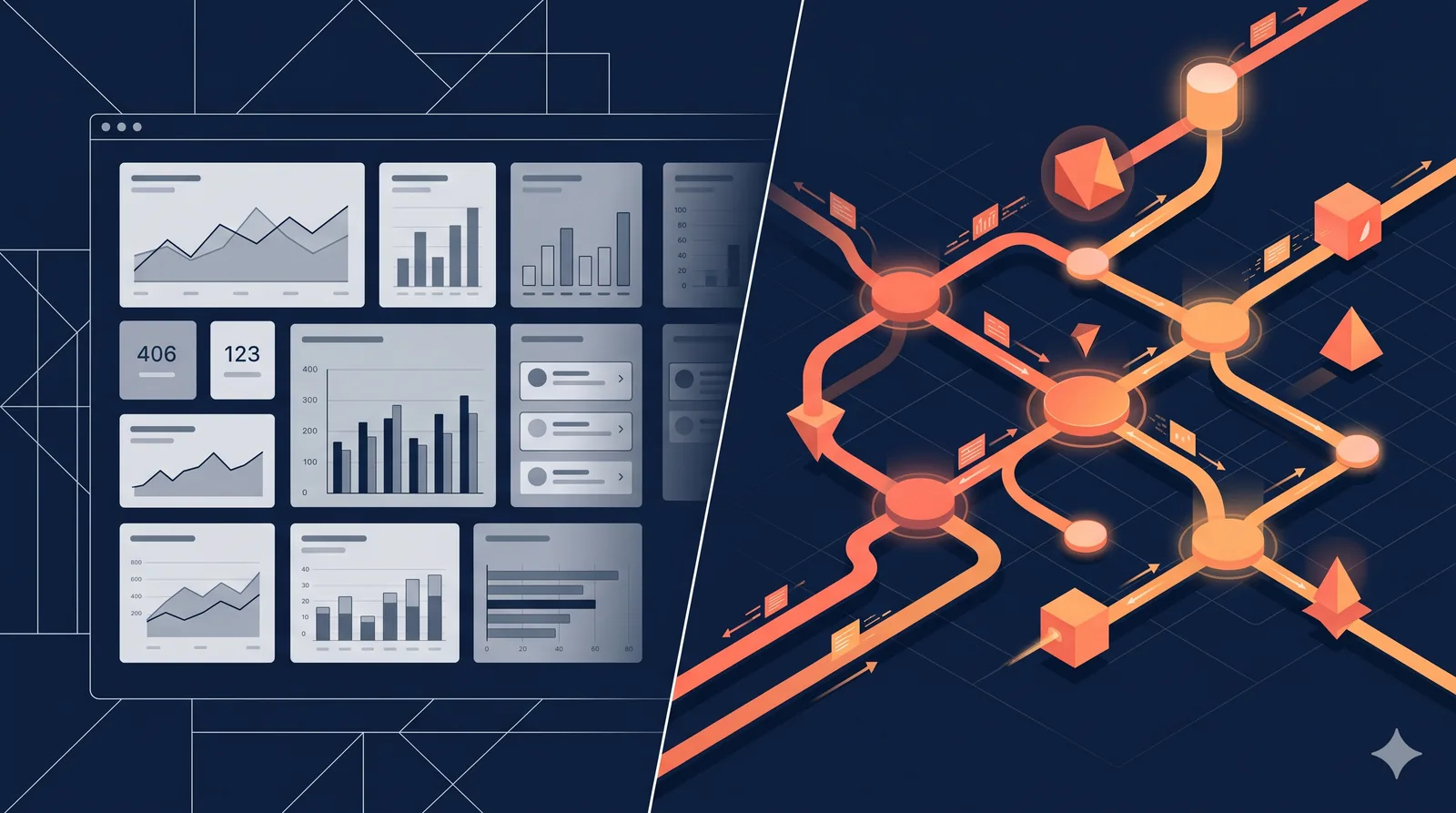
Digital transformation equips humans with digital tools. Agentic transformation reorganises the company by integrating AI agents as members of the organisation. This isn't an evolution, it's a change of nature.
Why did digital transformation fail?
Because it changed the tools without changing the processes. 70% of digital transformation projects don't achieve their objectives. Companies deployed ERPs, CRMs, cloud, but in the field, teams still use Excel in parallel. 45 to 65% of SMEs still manage their clients on spreadsheets.
The problem was never technical. It's an alignment problem between three worlds that don't speak the same language: the business sees "budget dispenser" in leadership, tech sees "weathervane" in the business, and leadership sees "Matrix" in tech.
Result: more than 80% of Data and AI projects fail. Not because the technology doesn't work, because nobody did the alignment work upfront.
What does agentic transformation fundamentally change?
It changes the role of AI in the organisation. AI moves from a point tool to a member of the organisation.
| Dimension | Digital | Agentic |
|---|---|---|
| Objective | Equip humans | Reorganise the company |
| AI's role | Point tool | Member of the organisation |
| Scope | Isolated task | Complete decision chain |
| Business expert | User of the tool | Centre stage, validator |
| Capitalisation | Nothing, back to square one | Durable Knowledge Graph |
| Ownership | With the provider | With the client |
The fundamental difference: in agentic transformation, AI doesn't replace human expertise, it makes it more valuable. What disappears is the invisible work of translation and re-entry that consumed 80% of time without creating value.
What are the signs that a company is stuck in digital transformation?
Four warning signals showing that the company has digitalised its tools but not its processes:
Shadow IT proliferates. Business teams deploy apps without IT, "IT says no, so we got a Notion subscription on the personal card." This is a sign that the official tools don't meet the real needs.
PoCs never reach production. The company launches AI PoCs, they work in demo, and die in workshops. 19% of AI failures come from "tool-first thinking": buying the tool before defining the problem.
Every project starts from scratch. No capitalisation from one project to the next. What's learned stays in individuals' heads, in PowerPoints nobody re-reads.
ROI is impossible to formulate. If you can't write the ROI of an AI project in one sentence, the scoping wasn't done.
How do you move from digital to agentic transformation?
In three steps, with the ICPC framework:
Start with scoping, not the tool. Identify a high-impact business process. Formulate the ROI. Align business, tech, and leadership before touching a line of code. Across 200 B2B AI projects studied in France, projects under €15K have a ROI 2.1× higher than projects over €100K, because they are better scoped.
Deploy in real conditions. Not in a lab. Systems with integrated human validation have 4× fewer critical incidents. Human-in-the-loop is not optional, it's what distinguishes a dying PoC from an application that lasts.
Capitalise from the first project. Encode what's learned in a Knowledge Graph. The next project doesn't start from scratch. That's the difference between "using AI" and "transforming with AI."
Is agentic transformation suited to SMEs and mid-market?
Yes, and the data shows they outperform. SMEs achieve a median ROI of +185% on their AI projects, vs. +120% for companies with more than 250 employees. Reason: organisational agility, less bureaucracy, faster decision-making.
Agentic transformation doesn't require a large enterprise budget. It requires rigorous scoping, an executive sponsor, and the will to capitalise. GenieFactory supports SMEs and mid-market companies with projects calibrated in the outperforming range: fast start, formulated ROI, deployment in weeks.
Assess your transformation maturity →
Next article: How to go from an AI PoC to production?