
Fire test automation
How we stabilized fire-test video analysis to deliver traceable metrics and a multi-site deployment-ready platform.
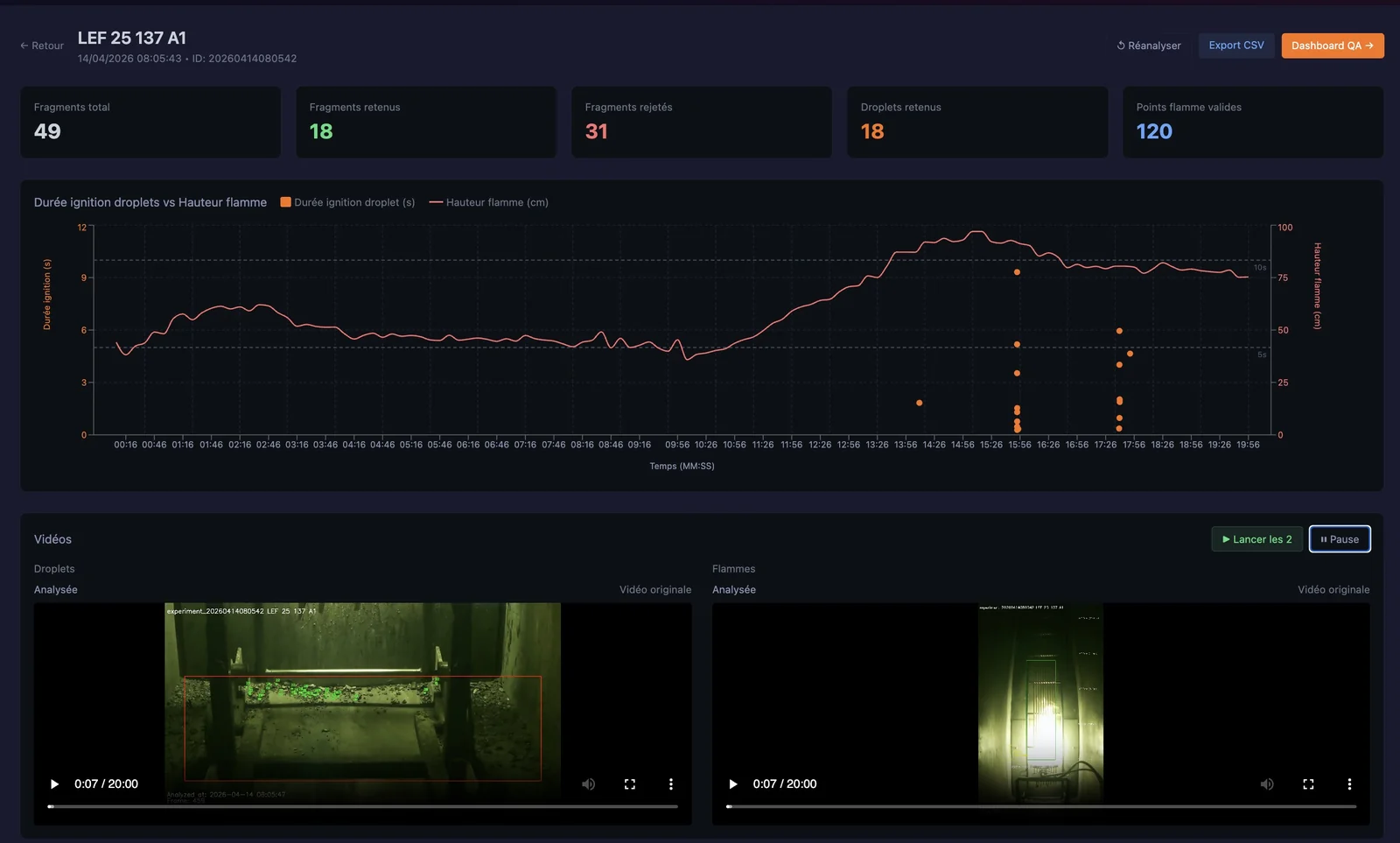
In brief. A European industrial group needed to make its fire-test video analysis reliable. We took over an unstable legacy pipeline, built an instrumented QA test suite, then scoped an industrialized V2 that is explainable and ready for deployment across multiple laboratories.
Context
An internal industrial lab runs regulatory fire behavior tests. Each trial is recorded for several minutes, and two phenomena must be measured frame by frame:
- flame dynamics (height, persistence, splits);
- incandescent droplets that detach from the tested part.
The existing solution had become difficult to operate:
- frequent false positives on reflections and bright zones;
- fragmented trajectories (one droplet counted multiple times);
- low-contrast droplets missed by detection;
- fixed analysis regions poorly aligned with real test dispersion;
- CSV outputs that were hard to interpret;
- legacy code with limited documentation and poor evolvability.
The business need was not "magic AI", but stable, explainable, and auditable measurements.
Our approach
Our intervention was structured in two phases.
1) Instrumented quality review
We first replayed the full test suite documented by domain experts to reproduce every discrepancy, characterize it, and prioritize it against two criteria: measurement criticality and occurrence frequency.
For each discrepancy family, we delivered:
- a precise technical root cause (threshold, parameter, detection logic);
- several fix options ranked by effort/risk;
- interaction warnings to avoid side effects across fixes.
This transformed a broad statement ("results are unreliable") into a concrete, prioritized action plan.
2) Scoped redesign for scale
In parallel, we defined an industrialized V2 with the client, built around three complementary tracks:
- Technician UX: operating interface, offline mode, CSV import/export;
- End-customer value: better video quality and secure result sharing;
- Scientific layer: multi-front tracking, parallax compensation, droplet mapping and sizing.
The target architecture uses two levels:
- an autonomous lab workstation (Linux + Docker Compose), real-time and network-independent;
- a centralized cloud platform to compare trials across labs and run advanced analytics.
What changed
- Traceable decisions. Every accepted or rejected droplet is justified by an explicit criterion, improving audit robustness.
- Readable deliverables. CSV outputs were redesigned (clear columns, raw/validated split, exclusion reason).
- Higher reliability without black box models. The system combines classical computer vision with versioned business rules instead of replacing everything with an opaque model.
- Deployment readiness across sites. A shared Docker image plus per-site configuration makes rollout to other laboratories straightforward.
Why this approach works
The value comes from three engineering choices:
- strict test-suite discipline before any refactor;
- explicit handling of sensitivity vs. false-positive tradeoffs;
- design aligned with industrial constraints (auditability, degraded mode, field maintainability).
Capabilities mobilized
- applied computer vision (detection, tracking, segmentation);
- legacy recovery and progressive refactoring;
- hybrid edge + cloud software architecture;
- software quality engineering (tests, milestones, business validation);
- multi-site industrialization and operations.